
Creative Placemaking in Tourism Planning

Updated: Jul 22, 2024
Placemaking, a well-known concept originally introduced by the Project for Public Space (PPS) in 2002, is defined as a multidisciplinary approach to urban planning that emphasizes creating vibrant, inclusive, and people-centered public space within communities. The concept itself is not a new idea, it was inspired by Jane Jacobs and William H.'s ideas about designing cities for people, which emphasize the social and cultural importance of vibrant neighborhoods and inviting public spaces.
Speaking of tourism planning and creating destinations, placemaking has a role in giving an identity and image to the communities to attract people, business, and investment. To achieve this, a tourist destination shall have multiple activities and experiences within it. There are four attributes associated with placemaking in creating high-quality places or destinations, which have been established by PPS: accessibility, activities, comfort, and sociability.
Moreover, the traditional/standard concept of placemaking has been elaborated further by Wyckoff (2014), who categorized placemaking into four types to help identify solutions to address specific issues in certain places, thereby fostering vibrant and high-quality destinations. The four types include Standard Placemaking, Strategic Placemaking, Tactical Placemaking, and Creative Placemaking. These types have different objectives and characteristics, which can be intertwined with each other to foster certain forms and functions, as shown below.

Creative Placemaking as a Tool for Reconnecting People and Destinations
Wyckoff (2014) argues that creative placemaking is a collaborative approach to shaping a great place and improving a community’s quality of life by harnessing arts, culture, local heritage, and creativity. The approach animates public and private spaces, rejuvenates structures and streetscapes, improves local businesses's viability and public safety, and brings diverse people together to celebrate, inspire, and be inspired (Markusen and Gadwa, 2010).
Creative placemaking efforts can be incorporated into tourism planning that aims to encourage destinations to not only reimagine their spaces but also bolster the human experience, leaving a lasting impression on all who venture there and forging meaningful connections between people and places they explore. In addition, creative placemaking not only creates visually appealing and memorable experiences for tourists, drawing them to explore beyond conventional sites and engage with locals but also contributes to enhancing the sense of place and identity of tourist destinations by celebrating heritage and preserving landmarks.
There are several efforts associated with creative placemaking in tourism that serve as catalysts for transforming places into vibrant, memorable hubs of activity. Through a series of tourist experiences, these initiatives bring new life into neglected spaces, enliven public space into art and creative space, and foster social cohesion and a sense of belonging among residents and visitors alike. Below are several strategies to implement creative placemaking in tourism planning:
Public art installation: both permanent and temporary/seasonal (pop-up) exhibition
Cultural Events and Festivals
Adaptive Reuse of Underutilized Space
Public Space Design and Activation: making streetscapes and parks to be more inclusive, accessible, and comfortable for various activities.
Immersive Experience: an interactive and multi-sensory attraction.
Implementation of Creative Placemaking
Creative Placemaking has been widely applied in some countries as part of enrichment tourist destination planning. Below are examples of Creative Placemaking implementations:
Seoullo 7017, Seoul, South Korea
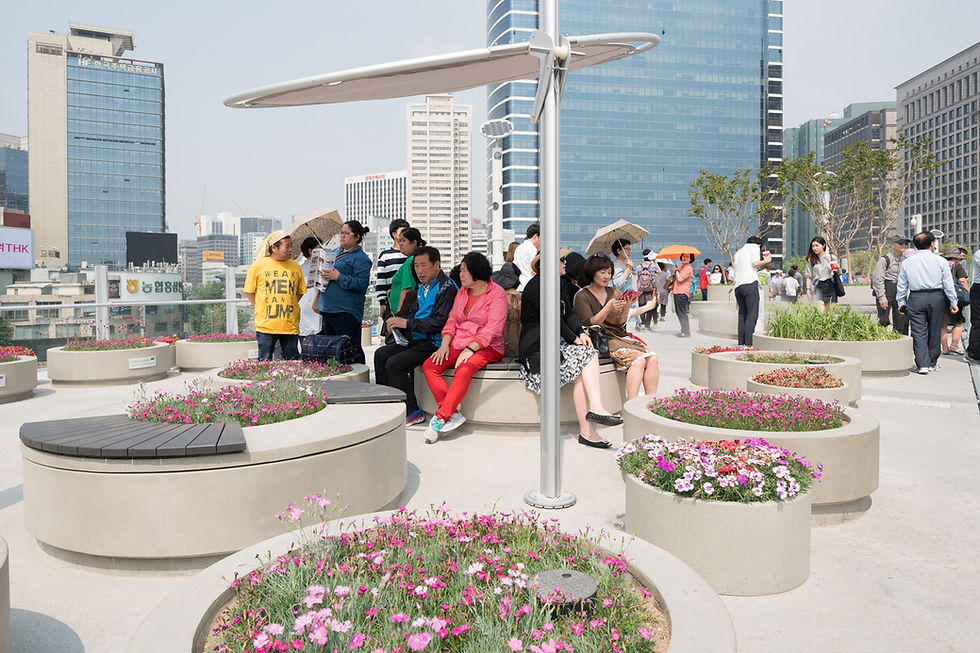
Soullo 7010 was initially a 938-meter-long highway established in 1970 and has been transformed from a rigid and car-oriented space into a vibrantly landscaped pedestrian bridge. This elevated walkway seamlessly connects urban dwellers to neighboring districts and key urban landmarks, including major train stations. Beyond its functional purpose as a pedestrian connection, the “sky garden” serves as a captivating tourist spot, with cafes, shops, exhibition spaces, landscape pavilions, a stage, a children's theater, and an information center.
Designed to enrich the user experience and activate public space, the sky garden has become an “inclusive and flexible space” that hosts engaging activities for communities throughout the day and night, fostering cultural and commercial vibrancy within the city. People can sit, relax, interact, and enjoy the city view from different perspectives.

Besides, the sky garden features a diverse collection of indigenous plant species, creating a dynamic landscape that blooms according to the seasons. This thoughtful design not only showcases Korea's local flora but also offers visitors a captivating experience throughout the year.
Light to Night Festival, Singapore
Over the past five years, Singapore has implemented creative placemaking approaches in tourism planning, with a focus on arts and culture. These efforts aim to activate and enliven physical spaces through cultural programming and partnerships, showcasing Singapore's identity, heritage, and uniqueness (Ethos Issues, 2018). One prominent example is Light to Night, among Singapore's largest art festivals, held annually as part of Singapore Art Week and organized by the National Gallery Singapore. During this event, visitors can explore over 60 captivating artwork trails and enjoy free programs scattered across Singapore's cultural destinations. The noteworthy initiative is the transformation of the passive open lawn in front of the heritage building at the National Gallery of Singapore into an "urban stage," where visitors can gather to experience mesmerizing art installations and engage in interactive light shows celebrating the building's heritage.

The festival has demonstrated how art and culture can establish a lively and meaningful destination for communities. Whether visitors are art enthusiasts or simply seeking relaxation, they can come together and engage with the district in captivating and enriching ways.
Teamlab Borderless, Tokyo, Japan
TeamLab Borderless in Tokyo, Japan, exemplifies how immersive experiences can be a ‘game-changing’ initiative of creative placemaking in tourism planning. This type of tourist destination is designated for a targeted audience, which engages the visitor's senses, evokes emotions, stimulates curiosity, and leaves a memorable experience. These experiences include interactive art installations, augmented reality (AR) or virtual reality (VR) exhibits, themed environments, and sensory-rich attractions (Fastercapital, 2024).

Teamlabs Borderless goes beyond digital art. The attraction redefines the connection between the spectator and the arts, offering a transformative experience where boundaries dissolve between the spectators, physical elements, and digital realms
a Transformative Concept of Creating Destinations
To sum up, creative placemaking emerges as a powerful and transformative strategy within tourism planning. The concept was proposed by Wyckoff in 2014 to broaden the traditional concept of placemaking by Project for Public Space (PPS). This initiative seeks to address specific challenges in certain places by infusing art, culture, and creativity into spaces, creating memorable destinations, and fostering social cohesion.
Furthermore, creative placemaking enables to reconnect individuals with places and destinations they visit and explore.
Creative placemaking emerges as a powerful and transformative strategy within tourism planning that enables to reconnect individuals with places and destinations.
Through innovative strategies and thoughtful design, creative placemaking initiatives breathe new souls into spaces, transforming them into dynamic hubs that beckon visitors to explore, engage, and forge meaningful connections.
Creative placemaking efforts in the tourism planning context can be implemented in several ways such as public art installation (both temporary/seasonal and permanent); rejuvenation of underutilized space to be an inclusive destination; activation of streetscapes and parks; and lastly, immersive experience which has been popular in the tourism industry as a captivating attraction that blurs a “border” between people and arts.
Last but not least, creative placemaking efforts shall not only provide beautiful physical forms and leave a lasting impression on people about the places but also serve as sustainable strategies for fostering social inclusivity, preserving local cultures, and stimulating economic growth.
References:
Project for Public Space, Inc., 2022. “Placemaking: What If We Built Around Places?”
Ann Markusen and Manne Gadwa, 2010. Creative Placemaking Executive Summary. National Endowment for The Arts.
Mark. A. Wycoff, 2014. DEFINITION OF PLACEMAKING: Four Different Types. MSY Land Policy Institute.
Ethos Issue 19, 2018. Reimagining Singapore: Placemaking through Arts and Culture. https://knowledge.csc.gov.sg/ethos-issue-19/reimagining-singapore-placemaking-through-arts-and-culture/.
FasterCapital, 2024, Experiential Marketing Strategy: How to Create Memorable and Meaningful Marketing Experiences for Your Target Audience. https://fastercapital.com/content/Experiential-Marketing-Strategy--How-to-Create-Memorable-and-Meaningful-Marketing-Experiences-for-Your-Target-Audience.html#Designing-Immersive-Experiences.
Wortley, Kathryn, 2024. Japan welcomes new teamLab attraction in Tokyo. https://www.ttgasia.com/2024/02/02/japan-welcomes-new-teamlab-attraction-in-tokyo/.
Archdaily, 2017. SEOULLO Skygarden / MVRDV.https://www.archdaily.com/882382/seoullo-skygarden-mvrd.
Quintana, Dani. Seoullo 7017: My Favorite Night Walk in Seoul. https://koreabyme.com/seoullo-7017-my-favorite-night-walk-in-seoul/
Comments